tawasuyu

una civilización autónoma en cada pixel

a self-governing civilization in every pixel

tawasuyu

Laboratorio de soberanía

A laboratory of sovereignty

Un sistema operativo bare-metal, un motor gráfico acelerado por GPU, un navegador web nativo, un compositor Wayland y una suite de más de cincuenta aplicaciones integradas. Un solo lenguaje, un solo formato entre ellas, ninguna cuenta que abrir.

A bare-metal operating system, a GPU-accelerated graphics engine, a native web browser, a Wayland compositor and a suite of more than fifty integrated applications. One language, one format between them, no account to open.

Del escritorio a la plaza. From the desktop to the public square.

01 · cuatro regiones01 · four regions

Qué es estoWhat this is

El software comercial moderno opera bajo una premisa de custodia forzada: exige identidades centralizadas, guarda los datos en infraestructura ajena y modifica sus reglas de ejecución sin consentimiento. tawasuyu está diseñado para la soberanía irrevocable del operador. No es una invitación al consumo de un producto: es un acto de secesión digital. No hay cuenta que abrir, no hay servidor que consultar, y si mañana esto desaparece, lo que tenés instalado sigue funcionando igual.

No es un ensamblaje de componentes de terceros, sino una sola pieza escrita en Rust:

  • Una sola identidad: claves Ed25519 auto-soberanas, generadas por el operador.
  • Un solo formato: almacenamiento inmutable y direccionado por contenido (BLAKE3 + DAG).
  • Un solo motor gráfico: rendimiento GPU directo, sin Electron, sin Chromium y sin toolkits heredados.

Lo que lo hace raro no es la cantidad de programas. Es que son todos la misma pieza: un solo lenguaje, un solo formato entre ellos, un solo motor que los dibuja — del primer sector del disco al cursor que parpadea. Por eso el número que sale de una planilla entra a un gráfico con su unidad puesta, la nota que escribís se puede firmar con la misma clave con la que votás, y el escritorio corre igual sobre Linux que sobre el sistema operativo propio. Adentro no hay dos mundos, así que no hay traducción entre ellos.

El nombre proviene del quechua tawa suyucuatro regiones— y dicta la organización misma de la base de código: el repositorio se divide en cuatro cuadrantes que corresponden de forma estricta a las etapas del ciclo de la información. No se trata de una división administrativa — el directorio asignado define la naturaleza del dominio.

  • 00_unanchay · percibir: captura de señales, ingesta de lenguaje, notas que se enlazan por resonancia semántica y entrada de datos crudos.
  • 01_yachay · conocer: modelado, cálculo determinista, verificación lógica y simulación de la realidad.
  • 02_ruway · hacer: ejecución, entorno de escritorio, creación visual y sonora, herramientas de acción.
  • 03_ukupacha · raíz: los cimientos que sostienen todo — el sistema operativo bare-metal, la red y la seguridad.

Modern commercial software runs on a premise of forced custody: it demands centralized identities, keeps your data on someone else's infrastructure, and changes its rules of execution without consent. tawasuyu is designed for the operator's irrevocable sovereignty. It is not an invitation to consume a product: it is an act of digital secession. There is no account to open, no server to consult, and if this disappears tomorrow, what you have installed keeps working exactly the same.

It is not an assembly of third-party components, but a single piece written in Rust:

  • One identity: self-sovereign Ed25519 keys, generated by the operator.
  • One format: immutable, content-addressed storage (BLAKE3 + DAG).
  • One graphics engine: direct GPU performance, with no Electron, no Chromium and no inherited toolkits.

What makes it odd is not the number of programs. It is that they are all one piece: one language, one format between them, one engine that draws them — from the first sector of the disk to the blinking cursor. That is why a number leaving a spreadsheet enters a chart with its unit attached, the note you write can be signed with the same key you vote with, and the desktop runs the same on Linux as on the project's own operating system. There are not two worlds inside, so there is no translation between them.

The name comes from Quechua tawa suyufour regions— and it dictates how the codebase itself is organized: the repository is split into four quadrants that correspond strictly to the stages of the information cycle. This is not an administrative division — the directory a domain is assigned to defines what that domain is.

  • 00_unanchay · perceive: capturing signals, ingesting language, notes linked by semantic resonance, and raw data entry.
  • 01_yachay · know: modelling, deterministic computation, logical verification and simulation of reality.
  • 02_ruway · make: execution, the desktop environment, visual and sound creation, tools for acting.
  • 03_ukupacha · root: the foundations that hold everything up — the bare-metal operating system, the network and security.
00unanchaypercibir01yachayconocer02ruwayhacer03ukupacharaíz
00unanchayperceive01yachayknow02ruwaymake03ukupacharoot
Las cuatro carpetas del repositorio. Mover un dominio de cuadrante cambia lo que ese dominio es.The four folders of the repository. Moving a domain from one quadrant to another changes what that domain is.
1.144
crates en el workspacecrates in the workspace
cargo metadata --no-deps
2.605.126
líneas de Rustlines of Rust
find + wc -l
61
dominiosdomains
ls -d 0*/*/
629
demos ejecutablesrunnable demos
find -path '*/examples/*.rs'
43
puentes a formatos ajenosbridges to foreign formats
ls -d shared/foreign-*/
El estado, antes de seguir. Esto es el sistema de investigación de una persona, en movimiento. Algunas partes se usan acá todos los días; otras abren bien y todavía no las vio nadie más; unas pocas son un documento de diseño. Cada ficha dice cuál es su caso, y cuando algo no se probó en hardware real, también lo dice. The state of things, before you go on. This is one person's research system, in motion. Some parts are used here every day; others open fine and nobody else has seen them yet; a few are a design document. Every card says which case it is, and when something has never been tried on real hardware, it says that too.

Una pantalla de verdadA real screen

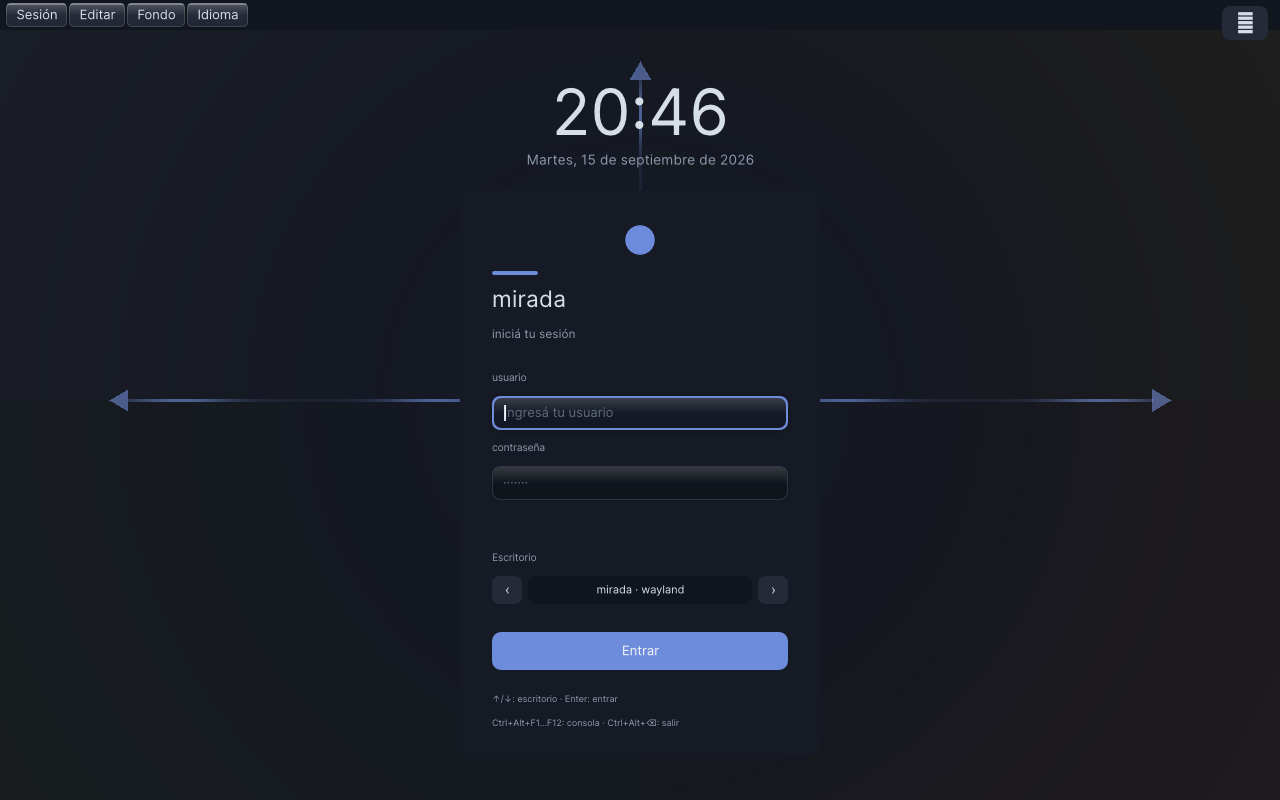
De todo lo que se ve en esta página, dos cosas son una pantalla fotografiada: ésta, y el escritorio sobre FreeBSD más abajo. El resto —las animaciones de las fichas— se dibuja sin pantalla, cuadro a cuadro: son fieles, y son dibujo.

Of everything on this page, two things are a photographed screen: this one, and the FreeBSD desktop further down. The rest — the animations on the cards — is drawn without a screen, frame by frame: faithful, and drawings.

mirada · greeter
La pantalla de inicio de sesión, tal como aparece al arrancar. Máquina FreeBSD 14.3-RELEASE, 15 de septiembre de 2026. Sin retoque. The login screen exactly as it comes up at boot. A FreeBSD 14.3-RELEASE machine, 15 September 2026. Untouched.

02 · las cuatro familias02 · the four families

Las aplicacionesThe applications

Las aplicaciones de la suite se organizan en cuatro familias. Cada una define su propósito, sus herramientas actuales y las metas concretas a las que apunta. Tocá una tarjeta para abrirla: adentro están lo que hace, a lo que apunta, cómo se corre, el README y la descarga.

The applications of the suite are organized into four families. Each one states its purpose, the tools it has today and the concrete goals it aims at. Tap a card to open it: inside are what it does, what it aims at, how to run it, the README and the download.

Cada ficha marca su peldaño — idea escrita, anda por dentro, se puede abrir, se usa acá, se usa todos los días — y las plataformas donde hay binario.Every card marks its step — written idea, works inside, you can open it, used here, used every day — and the platforms with a published binary.

Qué esWhat it is

La máquina y las herramientas fundamentales con las que se opera: lo que arranca, lo que procesa y dibuja cada píxel, la terminal, la gestión de archivos, el navegador, el sonido y la imagen.

The machine and the fundamental tools it is operated with: what boots, what processes and draws every pixel, the terminal, file management, the browser, sound and image.

Qué tieneWhat it has

La sesión de escritorio completa —compositor Wayland, barra, pantalla de inicio de sesión y ajustes—, la terminal con su multiplexor, el explorador de archivos, el editor rápido, un navegador web con motor propio, el motor gráfico vectorial acelerado por GPU, y el proceso número uno que hoy ejecuta servidores de producción.

The complete desktop session —Wayland compositor, bar, login screen and settings—, the terminal with its multiplexer, the file explorer, the fast editor, a web browser with its own engine, the GPU-accelerated vector graphics engine, and the process number one that today runs production servers.

Qué buscaWhat it seeks

Garantizar la soberanía operativa total de la máquina: que el control —desde el primer sector de arranque hasta el cursor en pantalla— pertenezca de forma absoluta al operador, sin intermediarios corporativos, sin motores web comerciales y sin dependencias de terceros, para que la máquina funcione de manera privada, determinista y directa.

To guarantee total operational sovereignty over the machine: that control —from the first boot sector to the cursor on screen— belongs absolutely to the operator, with no corporate middlemen, no commercial web engines and no third-party dependencies, so the machine works privately, deterministically and directly.

Una computadora que no controlás es de quien la controla. El precio está a la vista y es deliberado: primero anda, después es cómoda, y recién al final es linda.

A computer you don't control belongs to whoever controls it. The price is visible and deliberate: first it works, then it's comfortable, and only at the end is it pretty.

03 · los dos cimientos externos03 · the two outside foundations

Mismo sustrato, repositorios independientesSame substrate, separate repositories

Dos piezas clave operan en sus propios repositorios, fuera del monorepo principal, y sostienen la arquitectura global: una proporciona el entorno nativo donde la suite se ejecuta sobre el metal; la otra entrega la prueba matemática de que dos réplicas distribuidas pueden cooperar sin un servidor central. No se cuentan entre las aplicaciones de la suite, y tienen sitio propio.

Two key pieces operate in their own repositories, outside the main monorepo, and hold the whole architecture up: one provides the native environment where the suite runs on the metal; the other delivers the mathematical proof that two distributed replicas can cooperate with no central server. They are not counted among the applications of the suite, and they have their own sites.


04 · dónde corre04 · where it runs

Dónde correWhere it runs

Cualquier LinuxAny Linux

camino principalthe main road

Las aplicaciones sueltas corren en cualquier distribución. Y si querés, el escritorio entero reemplaza al que tengas: es una sesión Wayland más en la pantalla de inicio.

The individual applications run on any distribution. And if you want it, the whole desktop replaces the one you have: it is one more Wayland session on the login screen.

Se compila del repositorio con un comando, o se baja el binario.

Build it from the repository with one command, or download the binary.

WindowsWindows

ejecutables sueltosstandalone executables

Un .exe que se baja y se abre: sin instalador, sin tocar el registro, sin dejar servicios corriendo. Se desinstala borrando el archivo.

An .exe you download and open: no installer, nothing written to the registry, no services left running. You uninstall it by deleting the file.

Catorce aplicaciones tienen ejecutable publicado. La lista crece app por app, no de golpe, y tres todavía ni compilan para Windows.

Fourteen applications have a published executable. The list grows app by app, not all at once, and three still don't even compile for Windows.

AndroidAndroid

APKs firmadossigned APKs

El teléfono como una máquina más de tu conjunto. Veintitrés aplicaciones tienen APK firmado para bajar —la salud, la huerta, la asamblea, el fiao, el cielo, los juegos, el editor, el cuaderno— además del emparejamiento por código de seis dígitos, el ERP, la terminal y la consola para hablar con la flota. La misma aplicación que en el escritorio: no hay una versión móvil aparte, es el mismo código con otra pantalla.

The phone as one more machine in your set. Twenty-three applications have a signed APK to download — health, the plot, the assembly, the tab at the shop, the sky, the games, the editor, the notebook — plus six-digit pairing, the ERP, the terminal and the console for talking to the fleet. The same application as on the desktop: there is no separate mobile version, it is the same code with a different screen.

Ninguna se vio todavía corriendo en un teléfono. En el aparato de pruebas (GPU Mali) el motor gráfico pierde el contexto después del primer cuadro y la pantalla puede quedar negra; los APKs se publican para probar, no para usar, y están firmados con clave de desarrollo.

None of them has been seen running on a phone yet. On the test device (Mali GPU) the graphics engine loses its context after the first frame and the screen can stay black; the APKs are published to be tested, not used, and they are signed with a development key.

FreeBSDFreeBSD

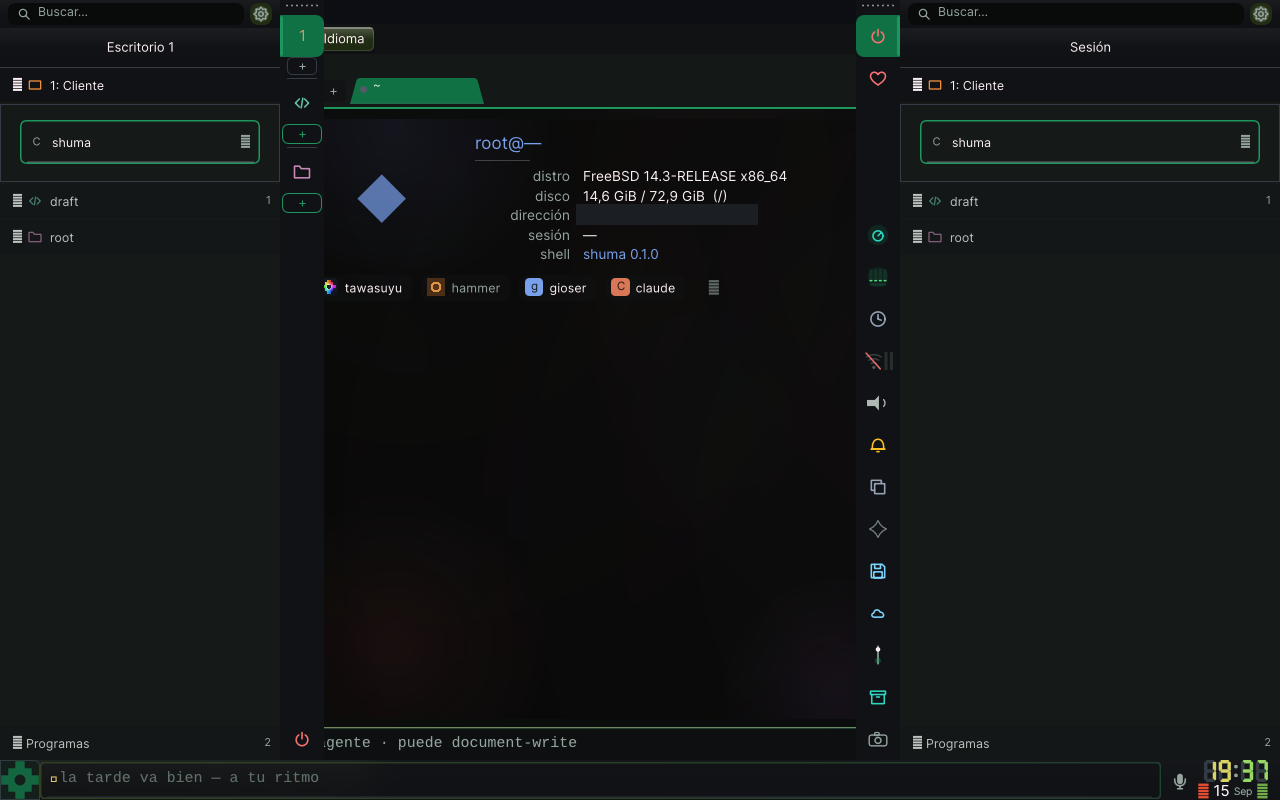
escritorio, login gráfico e init, instalados desde el repositoriodesktop, graphical login and init, installed from the repository El escritorio de tawasuyu sobre FreeBSD 14.3, en una máquina que no compiló nada: lo dice su propia terminal, adentro del cuadro.

El escritorio de tawasuyu sobre FreeBSD 14.3, en una máquina que no compiló nada: lo dice su propia terminal, adentro del cuadro.

The tawasuyu desktop on FreeBSD 14.3, on a machine that compiled none of it: its own terminal says so, inside the frame.

Medido sobre FreeBSD 14.3 nativo, no cruzado: el escritorio entero compila y hay 37 paquetes pkg firmados —treinta y seis aplicaciones y uno con el escritorio completo—. Una máquina que no compiló nada los instaló con el gesto de siempre y los abrió: compositor, barra y terminal corriendo juntos, con el shell informando «FreeBSD 14.3-RELEASE» desde adentro del cuadro. Desde el 15 de septiembre también se entra por la pantalla, con una pila de PAM escrita para ese sistema —la de Linux no sirve ahí—. Y el proceso número uno arranca la máquina: un servidor FreeBSD levanta con nuestro init, él pide la dirección de red y abre el acceso remoto, y el encierro se resuelve con jails. Falta el camino con pantalla física —esto se midió sobre un servidor sin GPU— y lo que el arranque clásico hace y él todavía no: revisar discos, memoria de intercambio, nombre de máquina.

Measured on native FreeBSD 14.3, not cross-compiled: the whole desktop builds and there are 37 signed pkg packages —thirty-six applications and one with the complete desktop—. A machine that compiled nothing installed them with the usual gesture and opened them: compositor, bar and terminal running together, with the shell reporting «FreeBSD 14.3-RELEASE» from inside the frame. Since 15 September you can also log in from the screen, with a PAM stack written for that system — the Linux one does not work there. And process number one boots the machine: a FreeBSD server comes up under our init, which asks for the network address and opens remote access, with confinement resolved by jails. Still missing: the path with a physical screen —this was measured on a server with no GPU— and what classic boot does and it does not yet: checking disks, swap, hostname.

Se instala como cualquier cosa de FreeBSD: se confía la huella, se agrega el repositorio y pkg install tawasuyu-escritorio. Probado el 2026-09-15 desde el sitio de verdad, en una máquina que no compiló nada, y con la prueba al revés: con un byte cambiado en la huella no baja nada.

It installs like anything else on FreeBSD: trust the fingerprint, add the repository and pkg install tawasuyu-escritorio. Tested on 2026-09-15 from the real site, on a machine that compiled nothing, and with the control arm too: with one byte changed in the fingerprint, nothing comes down.

takanatakana

en construcción, repositorio y sitio propiosunder construction, its own repository and site

La distribución de Linux donde esto va a vivir de forma nativa: abajo un laboratorio hermético que compila desde fuente y direcciona cada artefacto por su hash; arriba un Linux clásico y mutable de verdad, con FHS y todo. Ya tiene la cadena de compilación verificada bit a bit y un kernel propio que se reproduce idéntico.

The Linux distribution where this is going to live natively: underneath, a hermetic laboratory that compiles from source and addresses every artefact by its hash; on top, a genuinely classic and mutable Linux, with a real FHS. It already has the build chain verified bit for bit and its own kernel that reproduces identically.

tawasuyu va a ser su escritorio. La ficha entera está en takana.gioser.net.

tawasuyu is going to be its desktop. The full card is at takana.gioser.net.

wawawawa

imagen de demostracióndemonstration image

El sistema operativo propio, arrancando en metal desnudo sin Linux abajo. No es para uso diario y no pretende serlo: es la máquina sellada, donde un programa que no tiene un permiso ni siquiera puede nombrar la función que se lo daría — no está enlazada.

The project's own operating system, booting on bare metal with no Linux underneath. It is not for daily use and does not pretend to be: it is the sealed machine, where a program without a permission cannot even name the function that would grant it — it is not linked in.

Se baja una imagen de 1,3 MB y arranca en QEMU en menos de un minuto.

You download a 1.3 MB image and it boots in QEMU in under a minute.

05 · la chakana05 · the chakana

La chakanaThe chakana

de chaka: puentefrom chaka: bridge

La chakana es la cruz escalonada andina, con una perforación circular en su centro. Está tallada en piedra desde Chavín y Tiwanaku, y sigue apareciendo mil años después en el borde de un poncho que alguien teje hoy. Su nombre proviene de chaka, que significa puente: la estructura que conecta mundos, dimensiones y fases de transición.

El mundo que concibió esta geometría construyó redes viales que cruzaban continentes y terrazas agrícolas que siguen produciendo miles de años después, sin haber requerido rueda, hierro, moneda ni escritura alfabética. Su sostenibilidad no residió en un dispositivo técnico, sino en un modelo de organización del trabajo: ayni, la reciprocidad exacta y medible; minka, el esfuerzo voluntario volcado al bien común; y el ayllu, la comunidad soberana como unidad fundamental, en lugar del individuo aislado.

Cuando la conquista prohibió las asambleas, persiguió la lengua y quemó los registros, el tejido social no colapsó: el quechua continuó hablándose, las faenas comunitarias se siguieron convocando por turno y la cruz escalonada no dejó de tejerse. Lo que perdura en el tiempo no es lo que un dueño custodia en un servidor, sino lo que una comunidad sostiene.

De esa lógica proviene la arquitectura de tawasuyu. Un archivo nombrado por su contenido (BLAKE3) no posee un índice central que se pueda confiscar o censurar. Una identidad que es una clave criptográfica (Ed25519) no requiere un registro maestro que deba autorizarla o darla de baja. Una comunidad que decide mediante un umbral de firmas colectivas no depende de quién sea el dueño del servidor. Es la misma premisa de soberanía e inmutabilidad, implementada esta vez en Rust.

The chakana is the Andean stepped cross, with a circular hole at its centre. It is carved in stone from Chavín to Tiwanaku, and a thousand years later it still appears on the border of a poncho someone is weaving today. Its name comes from chaka, which means bridge: the structure that connects worlds, dimensions and phases of transition.

The world that conceived this geometry built road networks crossing what are now four countries, and agricultural terraces still producing thousands of years later, without wheel, iron, coin or alphabetic writing. Its durability did not rest on a technical device, but on a way of organizing work: ayni, exact and measurable reciprocity; minka, voluntary effort poured into the common good; and the ayllu, the sovereign community as the fundamental unit instead of the isolated individual.

When the conquest banned the assemblies, persecuted the language and burned the records, the social fabric did not collapse: Quechua went on being spoken, communal work was still called by turn, and the stepped cross never stopped being woven. What lasts is not what an owner keeps on a server, but what a community holds up.

That logic is where the architecture of tawasuyu comes from. A file named by its content (BLAKE3) has no central index to confiscate or censor. An identity that is a cryptographic key (Ed25519) needs no master registry to authorize it or strike it off. A community that decides by a threshold of collective signatures does not depend on who owns the server. It is the same premise of sovereignty and immutability, written this time in Rust.
06 · descargas06 · downloads

BajarloGetting it

Una línea instala la suite entera en cualquier Linux. No baja nada por su cuenta: trae churay, el instalador, y abre su ventana para que elijas qué querés. Las aplicaciones sueltas van a tu carpeta personal y no piden contraseña.

One line installs the whole suite on any Linux. It doesn't install anything by itself: it brings churay, the installer, and opens its window so you choose what you want. Individual applications go into your home directory and ask for no password.

Los APK de Android están firmados con clave de desarrollo y ninguno se vio corriendo en un teléfono: se publican para probarlos, no para usarlos. Los .exe de Windows no están firmados con certificado comprado, así que SmartScreen va a avisar.

The Android APKs are signed with a development key and none has been seen running on a phone: they are published to be tested, not used. The Windows .exe files are not signed with a purchased certificate, so SmartScreen will warn you.